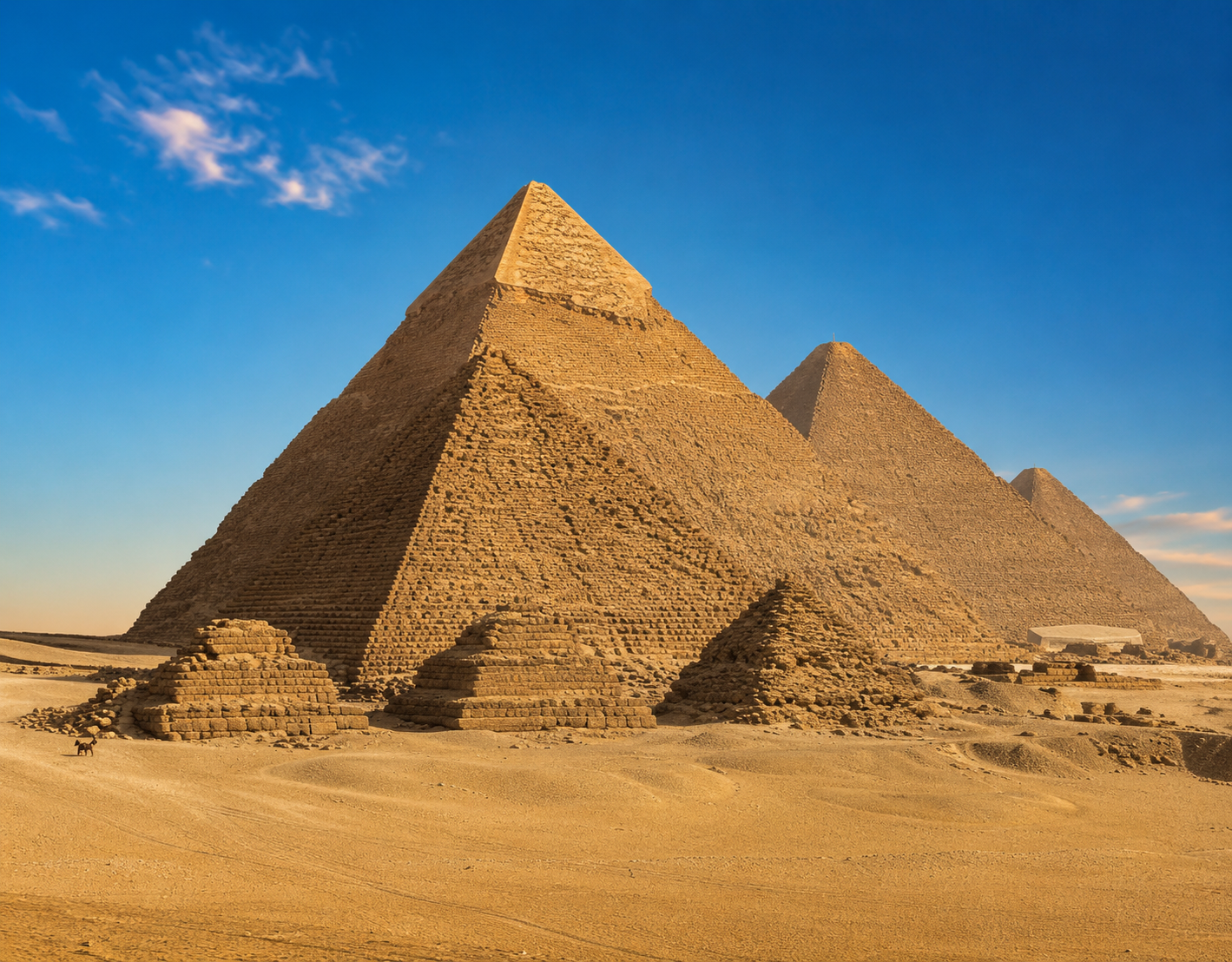
I couldn’t resist an article based on this paper that was published in March of 2026 on npj Heritage Science about the building of the Great Pyramid of Giza. For more than a century, the biggest question about the Great Pyramid of Giza has never really been whether the Egyptians could build it. It’s how they built it so quickly, and why, after thousands of years of digging around the base, nobody has ever found the leftover ramp that must have carried 2.3 million blocks of stone up into the sky.
The author, an independent researcher named Vicente Luis Rosell Roig, working out of Valencia, Spain, built a computer model that tests a construction idea called the Integrated Edge Ramp, or IER for short. The pitch is simple to say and complicated to prove. Instead of building a separate ramp out of extra dirt and rubble piled up against the pyramid, the builders may have just left a gap in the pyramid itself. A skinny, open air hallway running up the edges of the structure, made by leaving out a strip of blocks as they built each course, then filling that strip back in with stone once they didn’t need it anymore.
If that’s true, it would explain something that has bugged archaeologists forever. There’s no ramp left at Giza because there never was a separate ramp to leave behind. It was built into the pyramid the whole time, and it disappeared into the finished monument the same way it appeared, one course at a time.
The problem everyone’s trying to solve. The Great Pyramid stands about 146.6 meters tall, its base runs roughly 230 meters on a side, and it’s made of around 2.3 million blocks, mostly limestone, with some granite mixed in for the important rooms. Pharaoh Khufu reigned for about 27 years, and ancient records, including receipts and logbooks known as the Wadi al Jarf papyri, suggest the whole waterway system that fed the site could only really function for a window of about 20 to 27 years.
Do the math on that and you get something absurd. To finish the pyramid inside Khufu’s reign, workers needed to place roughly one block every three minutes, on average, for the entire project. Not per day. Per three minutes. That’s the kind of number that makes historians and engineers alike raise an eyebrow, because it demands a level of speed and coordination that older ramp theories can’t really explain without either using an impossible amount of material or blocking the builders’ own path.
The Egyptians of that era didn’t have iron tools, wheels for hauling heavy loads, or pulleys with multiple wheels working together. What they did have was copper chisels, sledges that could be dragged more easily over wet sand, rope, levers, earthworks, and barges that could move stone down the Nile. Any theory about how the pyramid got built has to work within those limits, not around them.

Why the older ramp ideas don’t quite fit? The paper walks through the main families of ramp theories that have been proposed over the decades, and lays out why each one runs into trouble.
A straight ramp running up one face of the pyramid would need an enormous amount of fill material, so much that it would have left behind a massive earthen mound at the base, and nothing like that has ever been found at Giza.
A zig zag or side ramp, switching back and forth up the face, would get in the way of the surveying work needed to keep the pyramid’s edges straight and its angles accurate, and it would block access to the corners.
An external spiral ramp, wrapping all the way around the outside of the pyramid, causes similar problems. It hides the corners from view, which matters a lot when you’re trying to keep four faces perfectly aligned as they rise, and it creates tight, awkward turns.
An internal spiral ramp, the kind proposed by French architect Jean Pierre Houdin, assumes there’s a hidden corridor running up inside the pyramid’s body. It’s a clever idea, but it doesn’t match up well with what modern muon scanning, a technique that uses cosmic ray particles to peer through solid stone, has found inside the structure.
And terrace or small step ramp systems add a lot of handling complexity and tend to create crowding between different work crews trying to use the same space.
Every one of these runs into some combination of the same three problems. They either use too much material, they block the view needed for surveying, or they leave a footprint that should still be visible today and isn’t.
What the Integrated Edge Ramp actually looks like? The IER tries to dodge all three problems by using the pyramid’s own edges as the ramp. As each course of the pyramid went up, the builders would skip a section of blocks along the active corner, three blocks wide and six blocks long, in a checkerboard style gap that created a corridor about 3.8 meters wide and 4.26 meters tall. Picture a narrow open air hallway wrapping around the outside edge of the pyramid, climbing with it as it grew.
The floor of that corridor followed the pyramid’s natural stepped shape, and workers smoothed it out with packed mud, short wooden planks, or sand to keep a steady grade of around seven degrees, tested against a range of six to eight degrees in the model. That grade turns out to matter a lot, because a slope that’s too shallow makes the path longer, and a slope that’s too steep makes the hauling harder. Seven degrees came out as close to the sweet spot.
At each of the pyramid’s four corners, the ramp turned ninety degrees and kept climbing up the next face. As the structure kept rising and narrowing, the ramp eventually had to be phased out too. Whichever section wasn’t being actively used got backfilled from the top down, restoring the smooth stone face and leaving no trace once the whole project wrapped up.
The researcher also built in three extra safety and practical features on top of the basic design. A low stone parapet, essentially a knee high wall, was added along the outer edge for safety once the workers were high off the ground. The corners were widened into small platforms, about five and a half meters on a side, to give crews room to turn their sledges and to give surveyors a stable spot to stand. And a wooden post at each corner did double duty, giving surveyors something to sight along for keeping the building square, and giving haulers something to loop a rope around to help manage the ninety degree turns.
How the model was actually tested? This is where the study gets interesting from a methods standpoint, because instead of just describing the idea, the author built three separate computer models and chained them together.
The first model is a geometry engine that recreates the pyramid course by course, subtracting out the ramp channel as it goes, and keeping track of exactly how many blocks are needed and where the ramp sits at every stage.
The second model is a logistics simulator, essentially a traffic model, that tracks how blocks move up the ramp one at a time, how long it takes crews to haul each block, how long it takes to navigate a corner turn, and how all of that adds up over the length of the project. This is the layer that answers the big question of whether the schedule actually works.
The third model is a structural engineering analysis, called finite element analysis, which is a standard technique engineers use to check whether a real structure can hold up its own weight without cracking or settling in ways that would be dangerous. This layer checks whether cutting a temporary hallway into the pyramid’s edge would have put too much stress on the surrounding stone.
All three pieces were built with real, named software, the code was archived publicly, and the study describes itself as fully reproducible, meaning anyone with the right technical background could rerun the whole thing and check the results themselves.
The physics behind the hauling. To figure out how many workers it takes to drag a block up a seven degree ramp, the model relies on two numbers that matter more than anything else, the slope of the ramp and the friction between the sledge and the ground.
For friction, the author settled on a baseline value based on experiments showing that wetted sand offers the least resistance to a sledge at around five percent water content, which lines up with the famous ancient Egyptian tomb painting showing a worker pouring water in front of a sledge being hauled. That detail has often been treated as just a ritual gesture, but it may have been a genuinely practical lubrication trick. The model tested a range of friction values anyway, just to make sure the results held up even under less favorable conditions.
Combining the slope and the friction, the model estimates that a team of about twenty three to twenty five workers, pulling with roughly three hundred newtons of force each, which is a modest, sustainable pulling force for one person, could move an average two and a quarter ton limestone block up the ramp.
The schedule, and why one ramp isn’t enough? Here’s where the numbers really start to tell the story. If the whole pyramid were built using just one single ramp, one lane, no parallel construction, the model says it would take about forty nine and a half years to finish. That’s nearly double Khufu’s twenty seven year reign, and it rules out a single ramp as the whole answer. Four ramps running at once, one wrapped around each face of the pyramid, cuts that down to about sixteen and a half years, because the average distance each block has to travel drops sharply and multiple crews can work at the same time without stepping on each other.
But the most efficient version isn’t a fixed number of ramps the whole way up. It’s an adaptive schedule that changes the number of active ramps as the pyramid gets narrower and needs fewer of them. The model lays out five phases. In the earliest phase, when the base is wide and there’s a huge number of blocks to move, the builders would have used up to sixteen straight ramps at once, four per face, to blast through the early bottleneck. As the structure narrowed, that dropped to eight ramps, then down to the four ramp helical system described earlier, then to two ramps on opposite faces, and finally, near the very top, down to a single ramp used for both going up and coming down.
That adaptive schedule brings the on site construction time down to somewhere between about thirteen point eight and twenty point six years, depending on exactly how fast crews could work and how much friction they were dealing with. Add in the time needed for quarrying the stone, moving it down the Nile by barge, and pausing construction during the Nile’s flood season, and the total comes out to somewhere between twenty and twenty seven years. That lines up remarkably well with the twenty to twenty seven year window suggested by the ancient Wadi al Jarf papyri.
The model also tested how sensitive that schedule is to slower work. If crews needed six minutes between placing each block instead of four, the timeline stretches to around twenty point six years, still just barely inside the historical window. Push it to eight minutes per block and the four ramp system alone runs past twenty seven years, though the adaptive schedule holds up a little longer before it does the same.
Building without wasting effort. One of the more interesting side findings has to do with how much extra work the ramp itself created. Building the ramp meant temporarily skipping certain blocks, and then putting them back later, which sounds like it could add a lot of wasted effort. But the model found that skipped blocks only ever amounted to somewhere between about half a percent and just under two percent of the total block count, depending on how many ramps were active at the time. In other words, creating this built in ramp system barely added any extra workload on top of building the pyramid itself.
The study also tracked how the actual physical effort, measured as mechanical work, changed as the pyramid rose. Early on, most of the effort goes into moving blocks sideways across the wide lower courses. Around course fourteen, the balance flips, and moving blocks up the ramp becomes the bigger task. The total workload peaks around course sixty six, roughly the point where the pyramid is a little under half built by volume, and from there the effort steadily declines as the structure narrows and there’s simply less stone left to move.
Handling the really heavy stuff? Limestone blocks were one challenge, but the granite beams used for the King’s Chamber were a different beast entirely. Some of those beams weighed between fifty and eighty tons, and their sheer length made them impossible to turn through the tight ninety degree corners the ramp system needed for lighter loads.
So the study treats granite handling as a separate, slower process running alongside the main limestone stream, not competing with it. Granite blocks moved on short, shallow ramps of only three to four degrees, lifted terrace by terrace in stages, using levers and wooden posts set up as makeshift capstans, essentially posts that let a rope be wrapped around them to multiply the holding force of a small crew. The model estimates this required drawbar forces of around ninety to two hundred kilonewtons per block, which sounds enormous, but when spread across multiple parallel ropes and a modest crew using the wrapped post trick, it came down to a manageable number of workers.
Importantly, the study calculates that moving all the granite and other heavy elements in the pyramid, something like four thousand tons of material altogether, took roughly twenty gigajoules of energy and somewhere around one hundred eighteen to one hundred forty two total working days of actual hauling time. Spread out over the multi year construction schedule, that’s a small fraction of the overall project, less than a tenth of a percent of the total energy budget. In plain terms, the granite megaliths were never the bottleneck. Most of the time spent on them was setup and rigging, not the actual heavy lifting.
Checking whether the pyramid could hold itself up? None of this matters if cutting a temporary hallway into the pyramid’s edge would have made it structurally unsound. So the study ran a full engineering stress test using the finite element method, essentially a way of breaking a 3D model of the pyramid into hundreds of thousands of tiny connected pieces and calculating how stress and weight flow through each one.
The results came back reassuring. Average stress in the limestone stayed around half a megapascal, with even the highest stress points only reaching around one to three megapascals. Limestone from that era can typically handle stress in excess of sixty megapascals before it fails, so the model found a safety margin of somewhere between twenty and fifty times what would actually be needed. The temporary ramp channels showed only small, localized dips in strength right around the ramp itself, nothing that suggested any risk of collapse or long term instability.
The study is careful to say this doesn’t prove the pyramid definitely could have been built this way, only that nothing in the structural analysis rules it out. It’s a plausibility check, not a guarantee.
Where this connects to modern scans of the pyramid? Here’s the part of the study that reads almost like detective work. In recent years, a research effort called ScanPyramids has used cosmic ray muon detectors to peer inside the Great Pyramid without touching a single stone, and it found some genuinely unexpected features, including a large hidden void known as the Big Void and a smaller corridor like structure near the north face called the North Face Corridor.
The author compared the predicted path of the Integrated Edge Ramp against the locations of these known voids and a handful of smaller cavities and notches picked up by the muon scans. Running the numbers across a range of possible ramp slopes, the closest match came out at a slope of around seven point four to seven point five degrees, which lined up with several of these anomalies to within about a meter and a half of uncertainty. The North Face Corridor in particular showed a close match in both elevation and depth, close enough that the study suggests a short temporary ramp or stairway might once have connected the main ramp system to that corridor and to the pyramid’s main entrance.
The study also compared the ramp’s predicted turning points to a published record of how thick each individual course of the pyramid is, since builders sometimes added a slightly thicker leveling course right after a major construction shift. At that same seven point four degree slope, five out of ten predicted turning points lined up closely with unusually thick courses, a result the study says is unlikely to happen by chance. To the author’s credit, this whole section comes with a strong warning label. These alignments are described repeatedly as hypothesis generating, not proof. Muon scanning right now can’t tell the difference between a backfilled rubble filled ramp channel and some other kind of void or density difference. The overlap is interesting and worth following up on, but it isn’t treated as confirmation.
What would actually prove or disprove this idea? One of the strongest parts of the paper is that it doesn’t just say the idea is plausible and stop there. It lays out a specific list of things that could be tested in the real world to check whether this theory holds up. If the pyramid really was built with backfilled edge ramps, ground penetrating radar or electrical imaging surveys should be able to detect rubble filled zones along the edges that look different from the surrounding solid masonry. Close inspection of corner blocks might turn up wear patterns consistent with sledges pivoting through tight turns over and over again. And if this theory is right, there should be no large ramp foundations anywhere around the base of the pyramid, something that’s already broadly true and would need to stay true. On the flip side, if a large external ramp base were ever found at Giza, that would seriously undercut the whole idea. The study is explicit that this is a testable, falsifiable claim, not just an interesting story.
How it stacks up against the competition? To make a fair comparison, the author ran the same computer model against three other well known ramp theories, using identical assumptions across the board, so nobody’s idea gets an unfair advantage. A straight external ramp, a spiral ramp running close to the pyramid’s edge, and Houdin’s two phase model, which starts as a straight ramp and then switches to an internal spiral.
Under those shared assumptions, the straight and spiral ramp designs both needed somewhere between about thirty five and fifty five years to finish, using a single lane at a time, which is well outside Khufu’s reign. Houdin’s model came out a bit faster, but still landed in the thirty five to forty five year range. The Integrated Edge Ramp, run under the same single lane conditions for a fair comparison, needed the shortest total travel distance for hauling blocks, and cut the total mechanical work required by roughly two thirds compared to the other designs. Once the model allows for the ramp to run in its full multi ramp, adaptive configuration, that’s what gets the timeline down into the historically plausible range.
The honest limitations: To its credit, the study spends real time on what it doesn’t know and can’t prove. There’s no direct archaeological trace of this specific ramp method yet, which is sort of the point of a design that’s supposed to disappear without a footprint, but it also means the theory currently rests on computer modeling rather than a smoking gun in the dirt. The friction and crew size numbers come from modern experiments and historical records, not from a firsthand account of exactly how many workers hauled a given block. The structural analysis assumes the limestone behaves as a single, evenly solid material, when in reality ancient stone has natural cracks and joints that could behave differently under stress. And the study only really models one specific pyramid built in one specific way, so it’s an open question how well this would generalize to other pyramids from the same era that were built with a different internal structure.
The author also flags that this whole approach assumes a level of planning, scheduling, and what amounts to logistics thinking that isn’t always credited to Old Kingdom Egypt. That’s less a flaw in the model and more an acknowledgment that if this theory is right, it says something notable about just how organized the builders’ management of the project must have been.
Why this matters beyond one pyramid? Setting aside whether the Integrated Edge Ramp turns out to be exactly right, the bigger contribution of this study might be the framework itself. The author built an open, reusable pipeline that combines geometry, real world hauling physics, and structural engineering into one system that can test any construction theory for any ancient monument, not just this one pyramid. All the code and data are published openly, so any other researcher with a competing ramp theory can plug their own assumptions into the same model and get a directly comparable result, on the same terms, rather than everyone arguing past each other with separate, incompatible calculations.
That, as much as the specific answer about ramps and corners and backfilled corridors, may end up being the most lasting part of the work. A shared, testable way to finally put these decades old pyramid building theories side by side and see which ones can actually survive the math.